Last Updated 20 February 2023
Whether you're an experienced beekeeper with dozens of colonies, or a newbee just starting out - hive design is one of the most fundamental components of beekeeping. Being able to open your hive, read a frame, and analyze what you see is critical to understanding your hive's overall health.
Continue reading below to advance your understanding of the different types of common hive designs and what you'll find inside each one.
Honeybees and humans share a long history, and beekeeping has evolved through many different methods and practices over the years. Over time, man-made hives have transitioned from rudimentary holes in trees to manufactured and custom-designed hive boxes coming in many shapes and sizes.
Choosing the right type of hive usually depends on the type of beekeeping you plan to employ, and there are advantages and disadvantages to each design. This article addresses the most common types of standard hive designs - the Langstroth, Warré, Top Bar, and Flow® designs - including their respective benefits and drawbacks, and provides detailed photos and specifications of each kind. However, keep in mind that beekeeping is a dynamic practice, and there are many variations of similar setups that we don't cover. We encourage exploring different styles of beekeeping and finding which type best suits you and your unique goals.
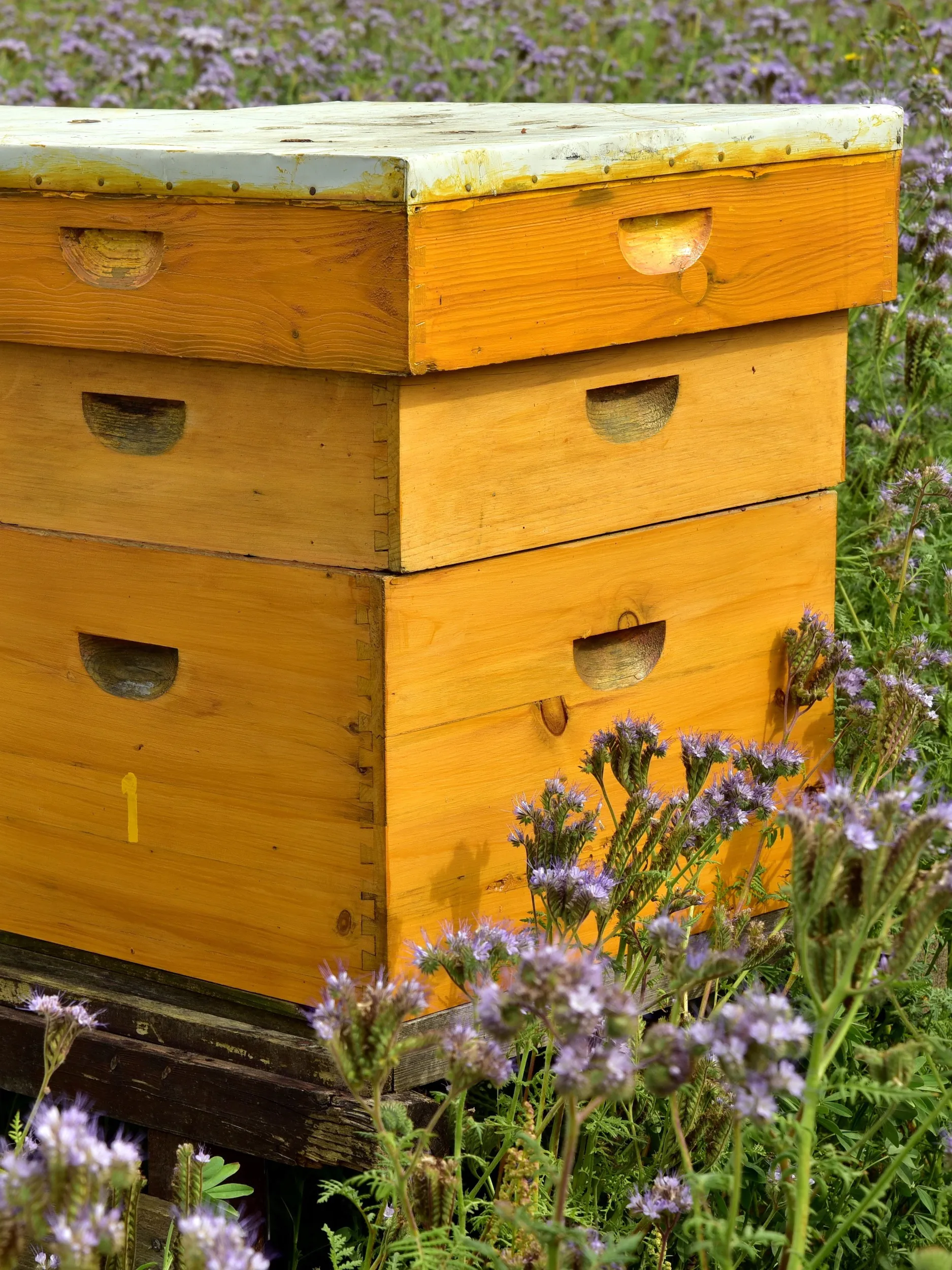
The most common type of beehive setup in western countries is the classic Langstroth hive. Composed of stackable boxes and individual honeycomb frames, the hive was invented by Lorenzo Langstroth in the mid-1800s. The design prioritizes convenience for the beekeeper and ease of access while mimicking honeybees' naturally-occurring vertical hive orientation.
Langstroth boxes come in three standard sizes (shallow, medium, and deep), with 5, 8, and 10-frame variations of these sizes, for a total of nine different dimensions. The standard deep 10-frame boxes typically measure about 19.8" x 16.1" in length/width with a height of 9.5", making them the deepest box (hence the name). Meanwhile, medium 10-frame boxes are about 6.5" deep, while shallows are about 5.75" in depth. Comparably, the 8 and 5-frame variations of these boxes have smaller widths of about 12.25" and 9.1", respectively.
The deep-sized boxes are typically used as the brood box, which is where the queen bee lays most of her eggs, and where the majority of pollen is stored for the developing larvae. Above the brood box, mediums and shallows are used as honey supers, where the bees store the majority of their honey collection. Beekeepers usually prefer to keep honey and brood as separate as possible to avoid contaminating the honey with excess pollen (or worse, baby bees), and sometimes use queen excluders to achieve this goal.
Part of what makes the Langstroth design so useful, however, is not its dimensions, but rather how the hive's frames are organized. Standard Langstroth hives include wooden rectangular frames, built to specific dimensions to allow adequate comb-building while maintaining enough space for the bees to walk between the frames, colloquially referred to as bee space.
There are three typical frame dimensions – deep, medium, and shallow – each matching their respectively-named hive boxes. By pairing each frame with its equivalently-sized box, hive customization and organization became much more possible, allowing beekeepers to expand their hives in times of productivity and limit their colonies during a dearth or winter seasons. Be aware that these dimensions are not exhaustive, and custom-built extra-deep or extra-shallow Langstroth frames aren't unheard of .
Beyond the different sizing options, many beekeepers also customize the actual makeup of the frames. Plastic or wax foundation is commonly inserted into the empty space within hive frames in order to add structural support for the worker bees to build their comb, saving resources (honey) used to make wax comb, and saving the beekeeper from the stress of having to deal with uneven or 'wonky' comb that the bees have built across multiple frames.
Some beekeepers argue that using foundation frames is unnatural, and even harmful to the bees. Foundation frames typically have pre-sized cells, which the bees then follow, leaving little room for their own natural design choices. Additionally, bees tend to leave large holes in parts of natural comb, likely for communication, airflow, and ease of access to other frames. With foundation these holes become impossible, potentially causing undue stress to the bees down the road.
The decision to use foundation or foundationless frames is one that every beekeeper must make – and there's no wrong choice! We recommend you experiment with both styles, going with foundation in one hive and foundationless in another, or even mixing up both in the same box. Find out what works best for your beekeeping goals through practice and observation, and know that there are successful beekeepers out there that swear by both styles.
There are many more variations and customizations having to do with Langstroth hives and frames. To learn more about this topic, read about hive parts.
Warré hives are a common alternative to the standard Langstroth hive, with one major difference - instead of rectangular frames, Warré hives use top-bar frames built from a single piece of wood or plastic. Like foundationless Langstroth frames, these bar frames give the bees complete control over how to build their comb, which can sometimes lead to messy cross-comb or unwanted burr comb. Additionally, Emile Warré (the inventor of the Warré) hive, chose to extend his hives downward instead of upward, adding new boxes beneath the current boxes and allowing the bees to continue comb-building downward, similar to their natural gravity-favoring comb pattern. This is not a necessity of the Warré hive design, and plenty of beekeepers add boxes to the top of their hives instead.
Due to the more natural, hands-off approach this hive design takes, beekeepers who want to monitor their hives closely and complete inspections on a more common basis may want to avoid this design in the beginning. Harvesting honey, inspecting your colony, and even opening the hive can become increasingly difficult with this hive design due to unexpected comb complexity, even though it may be more suited to the honeybees themselves. To add to the inconvenience, given the low stability of the frames with no supporting foundation or rectangular sidebars, it can be quite easy to damage comb while inspecting, killing bees and brood in the process.
Top bar hives (sometimes referred to as horizontal hives) are one of the most well-established iterations of hive design – taking inspiration from African beehives originally built with horizontally-oriented hollow tree stumps. Similar to the Warré hive, these hives use top-bar frames, allowing honeybees to build comb to their own specifications and preferences. In contrast to standard Warré hives, these hives are oriented horizontally, meaning that no two frames are ever stacked on top of each other. To manage hive size, vertical 'shim' dividers are used to limit colony expansion, acting as artificial walls between used and unused frames. Some beekeepers even use these to divide multiple hives in one top-bar box, improving honeybee yield and allowing for simultaneous queen rearing in a single hive.
Unfortunately, this unique trait of top bar hives is also the source of common criticism from beekeepers. Given that honeybees prefer to naturally draw honeycomb vertically, building downward with gravity as they expand, expert beekeepers point out that the top bar hive design makes it excessively difficult for honeybees to build out their home, as they have a harder time transferring horizontally over frames. Additionally, during the harsh winter season, honeybee clusters can find it exceptionally difficult to move across frames towards additional food stores compared to moving vertically along frames, meaning that if the air is too cold the cluster could starve only one or two frames away from plentiful food stores.
Despite these criticisms, a distinct benefit of this hive design is the lack of heavy load-bearing exercise during inspections and honey harvesting. Since no boxes have to be lifted or added on, the heaviest objects that have to be manipulated are single honeybee frames, which weigh only 5 to 15 pounds. For beekeepers who struggle lifting heavy objects or manipulating large wooden boxes, this hive design can save time and trouble down the road. Expanding or reducing the hive's size can be as simple as moving several frames outside of the dividing wall, and inspections only span one box's length. These advantages, coupled with plexiglass observation windows that many of these hive designs include, make it no surprise that this hive design remains one of the most popular out there today.
There are many more variations and customizations having to do with top bar hives and frames. To learn more about this topic, read about hive parts.
We wouldn't be doing our due diligence if we didn't at least touch on the latest in beehive inventions. In recent years, the Australian company Flow Hive® made headlines with their new flow frame design. Flow hive boxes are nearly identical to standard Langstroth designs – the real magic is in the flow frames themselves. Co-founders Cedar and Stuart Anderson invented a creative plastic honey frame coupled with a toggleable comb locking and unlocking mechanism, allowing honey to be drained through the frames and straight out of the back end of the hive box – without having to open the hive at all.
The widely-used Langstroth design paired with the highly-desired ease-of-use factor of the flow frames made the Flow Hive a rapid success in the industry. And while there are beekeepers who enjoy the ease of harvesting honey without having to open the hives, it's important to remember that beekeeping is not only about the end goal. Taking care of your bees, whatever that means for you, is the most responsible requirement of owning honeybee colonies, and due care in avoiding colony neglect should be taken when opting for an easier approach to this aspect of beekeeping.
So now, you might be asking which hive design is best for you. The answer really depends on your individual beekeeping goals. Top bar hives may be more convenient for those who have trouble moving large objects, while the Flow Hive® might save you lots of time while harvesting honey. Traditional Langstroth designs are the current standard for most commercial beekeepers, but don't let this fact intimidate you from exploring other alternatives. Experiment with several options, or even take aspects from each hive and build your own! Common features such as insulation or observation windows can be added or removed to suit your desires, and at the end of the day, as long as you keep healthy bees, they are more than likely happy to live wherever there is room.
© BeekPedia. All Rights Reserved.
Images and videos provided courtesy of copyright owners.