Last Updated 24 February 2023
Of all the workers in the hive, the queen bee is the most important. She is the mother of all bees in the hive, and stimulates the activity of the workers based on the colony's needs. Without her, the colony would eventually die out.
Gain a deeper understanding of how she works, why she's so important, and how beekeepers interact with their queens in this guide.
Contrary to popular belief, the queen is not the leader of the hive. She is a worker bee like any other, except that since birth she has had only one role: to lay the entire working force of the colony. And it's no easy feat - the queen will lay up to her body weight in eggs every day during the active months. That's up to 2,000 eggs per day!
Typically, the queen is limited by the amount of food coming into the hive, as well as the amount of empty cells that are free to lay eggs in. A productive queen will push the colony to continue bringing in resources as well as maintain enough space necessary for her to lay new eggs. More frugal queens will hold off on laying eggs while resources are scarce, producing a smaller brood pattern during periods of dearth so the colony can save on excess honey & pollen stores.
Highly inquisitive readers might ask how she does this. To answer this question, we must understand how hives communicate. Bees share special signals called pheromones with each other in order to efficiently communicate with other bees, and often the entire hive at once. The queen bee has a special pheromone, known as the queen mandibular pheromone, or QMP, that signals the entire hive of her presence. Her loyal attendants, which surround her in a circle and groom and feed her constantly, spread this QMP around further, until every single bee in the hive is aware of her presence. This way, the entire colony will know if they have a queen, as well as where she is, at any given moment, based on the strength and location of the most recent QMP passed around.
In addition to letting the workers know that she's alive, the queen's QMP also serves as an inhibitor for worker bees' reproductive organs, which prevents laying workers, a common problem with queenless hives. The strength of a queen's pheromones is also an indicator of her age and overall health. If her QMP is too weak, it may signal the hive to start preparations for queen supersedure, the natural way for hives to replace their queen. Finally, a virgin queen's pheromones also serve as an attractant for male drones, so that she can mate efficiently.
Altogether, a healthy queen leads to a healthy hive. Since the queen determines the hive's genetics, beekeepers often seek out highly productive queens with good traits, and many commercial breeders ship out queens from lines that have proven to be strong. Cultivating the genetics of your queens can help diversify your apiary and provide a long-term source of successful colonies.
The queen begins her life as a fertilized egg inside of a cell, like all other female worker bees. As she hatches, she is immediately fed an exclusive diet of royal jelly, which stimulates the larva to develop into a young virgin queen, rather than a worker bee (which are fed mixtures of royal jelly as well as pollen and nectar). Around days 7-8 of developing, the worker bees cap off the top of the now fully-developed queen cell, allowing the queen to undergo her metamorphosis and emerge. Queen cells are much larger than worker and drone brood cells and look like unshelled peanuts. They can be empty (often referred to as queen cups) or have an egg/larva inside, at which point it is a queen cell. After 16 days of spending her time as an egg/larva/pupa, she starts to chew her way out of her cell and emerges ready to mate.
At this point, the young queen's QMP is still relatively weak, and the workers do not pay much attention to her. Depending on the circumstances of her upbringing, the young queen may have to engage in combat with other queens in the hive for the right to become the sole queen. To do this, the virgin queen begins piping as a way to signal other queens of her presence. This can be heard by the beekeeper as a high-pitched whine coming from within the hive. Once two queens find each other, they fight, each trying to sting the other. The victor earns her right to life and a chance to mate. Interestingly, this appears to be the sole purpose of the queen's stinger. Queens will not sting beekeepers or other insects, even under extreme duress. This is likely due to the fact that queen bees have evolved to be rather timid and avoid confrontation, so as to reduce the chance of being harmed and leaving the colony queenless.
After her well-earned victory, the young virgin will spend a few days maturing and preparing for her mating flights. Once ready, she will begin leaving the hive for up to 30 minutes at a time and mate with male drones at drone congregation areas. After spending about a week performing these flights, the queen will return to the hive fully mated and ready to start producing eggs. Sometimes, if a mated queen returns to a colony that already has an older queen, the workers will kill one in favor of the other. Such is the brutal life of the queen bee.
Once mated, the queen will likely never leave the hive again, excluding hive swarms and colony absconding. She will remain well-fed and taken care of by her attendants, and will likely lay over 1 million eggs over her 2-5 year lifetime, after which she will run out of sperm and the colony will replace her.
Pictured Below:
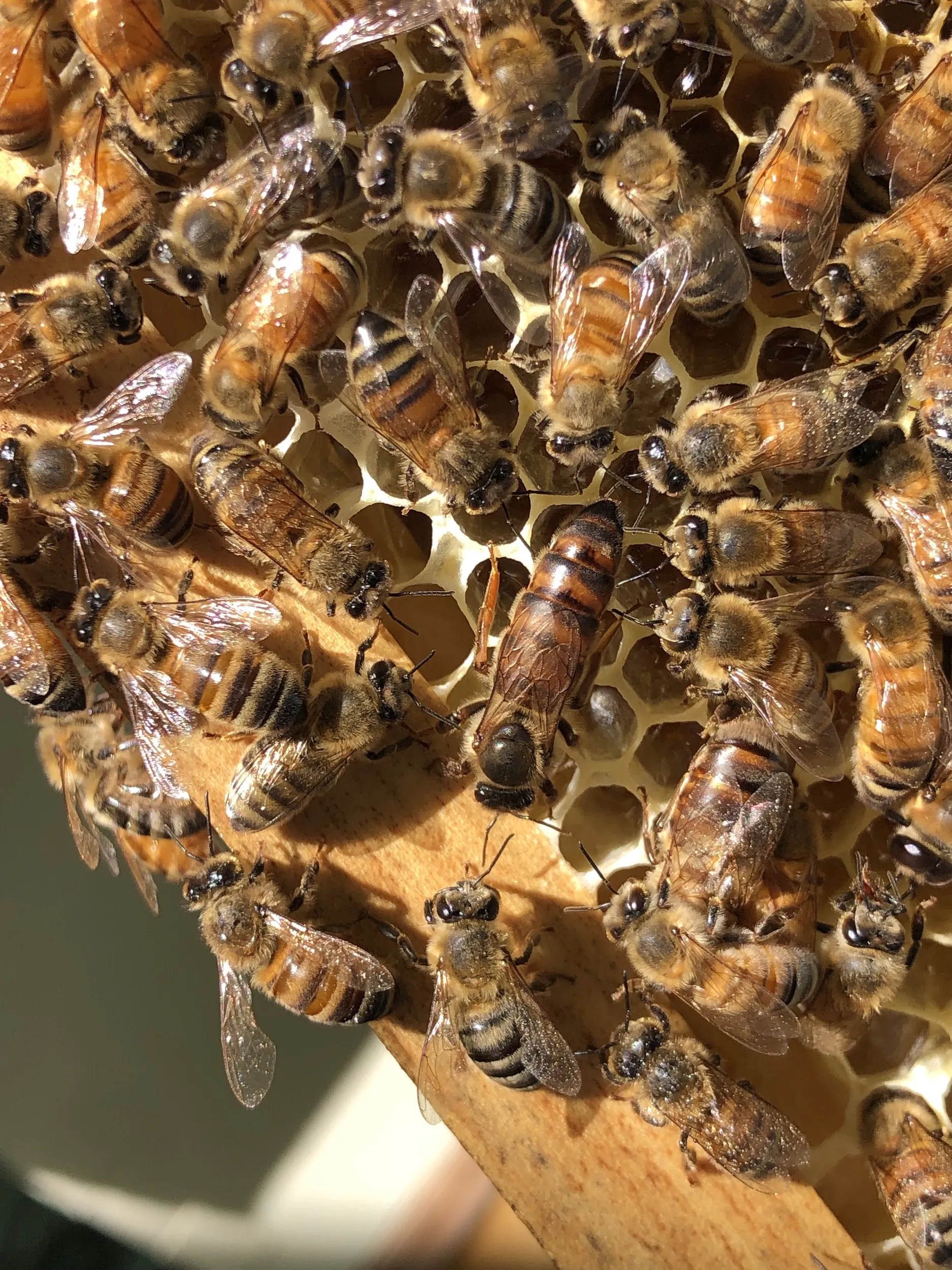
Virgin Queen (left) (top) vs Mated Queen (right) (bottom)
Image courtesy of Austin Cordell
Image courtesy of Austin Cordell
Often times, rather than allowing a colony to raise a queen themselves, beekeepers will order queens from local or commercial apiaries, selecting for genetics that are well-established and available. These commercial queens typically come in a queen cage with several attendants and a candy plug. The beekeeper can then either directly release her into the hive, or slow release her by opening up the end with candy blocking the entrance.
By ordering queens from queen breeders, beekeepers can save their colony the taxing resources and time it takes to produce a new queen on their own. However, extra care must be taken when introducing a new queen into a colony, as it takes time for the bees to accept a queen as their own and become familiar with her QMP. For more information, read about queen introductions.
The queen bee is the largest bee in the hive, nearly twice the length of worker bees. She has an elongated abdomen, with short wings compared to her body size. She's typically golden in color, but may have some darker stripes or even be completely black depending on her genetics. Unlike drones, her eyes are not relatively large, and she typically has a shiny black thorax with no hair on her back. She walks in large strides rather than small waggles, and will usually be surrounded by a circle of nurse bees caring for her. One strategy to spot the queen is to focus on a broader view of the frame, looking for an area where the bees seem to be suddenly moving out of the way. This is often a sign that the queen has just passed through.
Some beekeepers mark their queens using pens to make finding them easier; however, this is not necessary, and often times worker bees will groom the paint right off of her anyway.
Not necessarily. Queenspotting can be a difficult thing to master, and even then queens can hide on the sides of hives or at the bottom. During a typical hive inspection, the most important thing to see is evidence of a productive queen (eggs, larvae, and pupa of all stages). If you see those, you know with certain confidence that she's in there and laying properly.
It's up to your individual beekeeping goals. Hives create new queens for one of two reasons - swarming or superseding. Swarming is a hive's natural way of splitting itself in two, and without swarms honeybees would go extinct. Swarm cells typically come during the spring and summer months, when your colony is packed full of bees. There can be anywhere from 3-20 swarm cells, usually concentrated at the bottom of the frame, all with young queens at different stages of development. Destroying swarm cells may stop swarming in the short term, but to prevent swarming in the long run, artificial splits must be taken. Learn more about signs of swarming.
Supercedure cells are typically more spread out across the frame, and there may be only 1-10 depending on whether it was a planned supersedure or not. The bees might think there's an issue with their current queen, and you may find a bad brood pattern or no eggs at all! If a hive lost its queen suddenly, it must create emergency supersedure cells in order to survive. If the hive has been planning to supersede its queen for a while, it has more time to prepare in advance, and will have several eggs specially picked out as queen candidates. It's important to allow these young queens to continue developing unless you plan on installing your own new queen; otherwise, you may inadvertently make your colony hopelessly queenless.
Differentiating between the two types of queen cells can sometimes be difficult; however, looking for key signs and inspecting the general health of your colony will give hints as to what their plans are. The general rule is that a healthy, thriving colony will produce swarm cells, which can be removed to temporarily inhibit swarm tendencies. A weak colony with a bad queen will produce supersedure cells, which should not be removed unless you plan on introducing your own queen.
It's up to your individual beekeeping goals. Queen excluders are often used by commercial beekeepers to prevent queens from laying eggs in honey supers, which would prevent a beekeeper from harvesting honey from those frames for as long as brood is present in those cells. Hobbyist beekeepers sometimes use queen excluders to achieve similar results; however, there is much debate on their overall effectiveness. Some refer to queen excluders as 'honey excluders,' due to the fact that workers are less willing to cross over a queen excluder compared to wax comb. Still others argue that queen excluders are unnecessary, since the honey that workers store in the cells of the honey super act as a natural barrier that queens avoid anyway. To complicate matters further, queen excluders are not 100% effective, and some queens have been observed to squeeze through them, potentially injuring themselves in the process. Excluders will not prevent swarming, and can sometimes trap drones from being able to leave the hive.
If you have time to go through your honey supers thoroughly and check for brood, queen excluders may not be necessary for your apiary. If you would rather avoid the chance of having brood in your supers and can tolerate the potential risk of a slower honey or wax production, then install queen excluders. If you have multiple colonies, experiment with your hives and find out what works for you. Ultimately, the decision depends on your desires and how much time you dedicate to your hive maintenance.
The queen is not the leader of the hive. Honeybee colonies operate as a unit, and no single bee makes decisions for the colony. In fact, the queen lives a life closer to slavery than that of royalty. The worker bees bully her into laying where they want, they overfeed her to stimulate egg production and starve her when they need her to fly. The workers will ball up a queen they don't like, overheating and killing her without a second thought. They'll guard her fiercely and ensure her safety, until one day they decide to overthrow her. It's a brutal life being a queen, and one that gives little room for lavish tendencies.
While it is true that in egg-laying mode the average queen is too heavy to fly, it is definitely not something to rely on. Queen bees have a fully functional pair of wings, and if they are stressed out enough they can fly just far enough to orphan themselves from the hive. Extra caution must be taken to ensure your queen isn't spooked and flies away on you.
Additionally, all queens must be able to fly when a colony is planning on swarming. To allow this, the workers stimulate the queen to stop producing eggs temporarily by starving her, ensuring she is light enough to keep up with the swarm once they depart.
Like most other animals, virgin queens do not mate with related drones inside the hive. Mating with siblings can lead to genetic deficiencies and a lack of genetic diversity, both of which can be problematic down the line. Queens fly to drone congregation areas in order to mate with 10-30 drones, ideally from other hives in the area. A large assortment of sperm from many different colonies provides genetic diversity in the hive, ensuring the colony gets workers with different traits and that excel at many different jobs.
© BeekPedia. All Rights Reserved.
Images and videos provided courtesy of copyright owners.