Last Updated 25 February 2023
The honeybee brood cycle is one of the most important elements in beekeeping to understand. Brood is the entire future of the colony, and without a healthy amount of developing bees, the colony would not survive.
Learn what to look for while inspecting your brood chambers, and find out common ailments associated with brood below.
Most of a honeybee colony's immediate workforce is dedicated to the production of baby bees, or brood. Brood production starts with the queen bee, who lays up to 2,000 eggs every day. The queen focuses her efforts around the center of the brood boxes, usually beginning by laying eggs in the very center of frames, and then working in a circular pattern around the frame until she runs out of space. The queen is very picky about the cells she lays her eggs in, and if a cell is not the correct dimensions or not clean enough, she'll skip it. When she comes to an empty cell, she'll inspect it for debris, and then measure it with her front legs. Depending on the size of the cell, she will either deposit a fertilized female worker egg or an unfertilized male drone egg. She will then move on to the next cell, doing this over and over again for her entire life.
Eggs are typically laid standing up vertically at the bottom of the cells, and over the next three days will fall over horizontally onto the bottom of the cells. On day 3, the egg hatches, and a tiny, milky-white larva about the size of a pinhead emerges. Nurse bees immediately surround the new larva in a pool of royal jelly, and the young larva immediately begins consuming the jelly and growing in size. For queen breeders, queen grafting typically occurs at this very young larval stage, just after the egg has hatched and been fed royal jelly. After spending a few days growing in size, the larva will differentiate into one of the three bee classes, as designated by its genetics and diet.
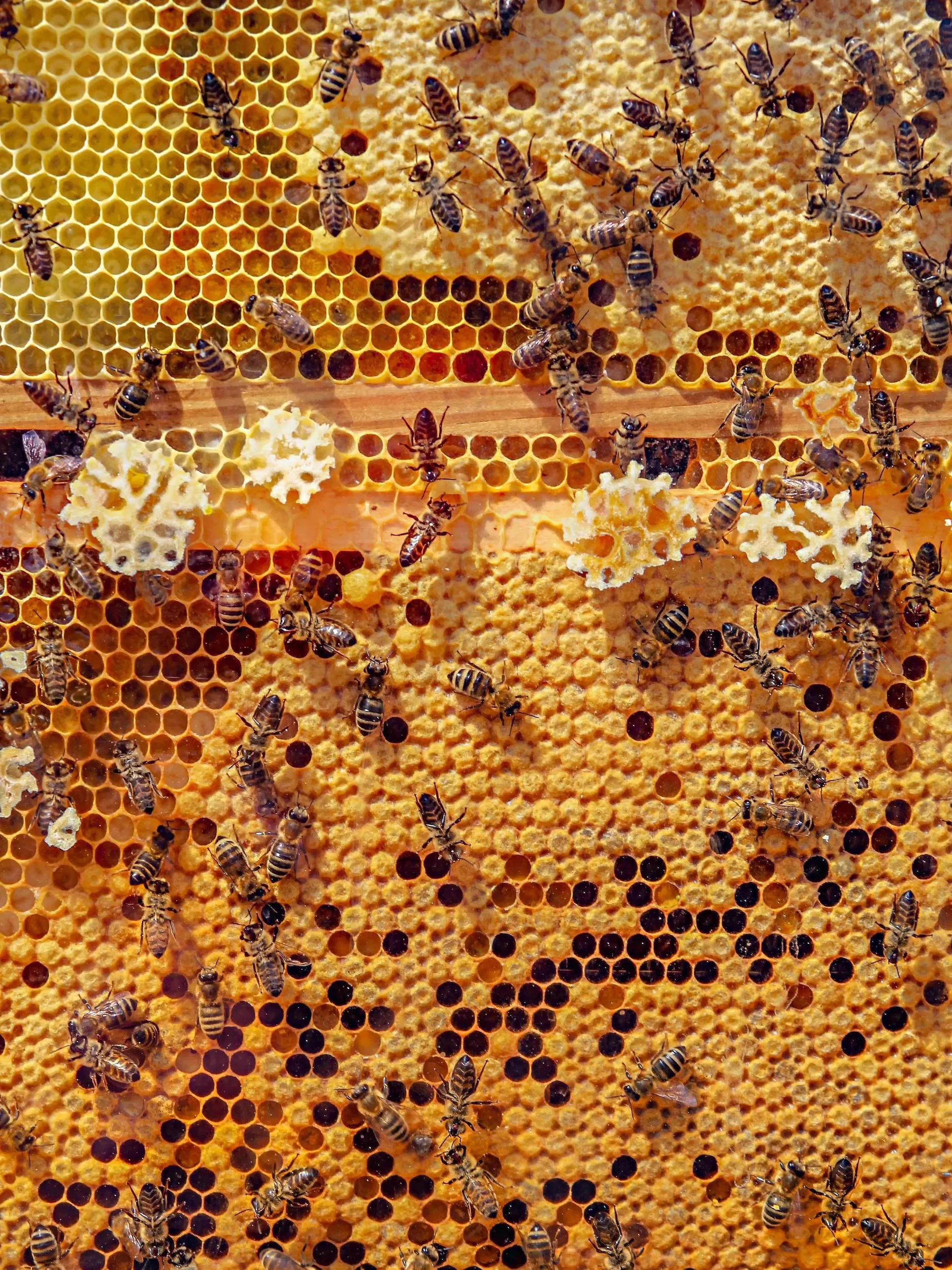
The large majority of brood in a colony is worker brood. Worker brood consists exclusively of fertilized female eggs, larvae, and pupae. Worker brood cells measure about 5mm in diameter, and are typically found in the central frames of brood boxes, surrounded by a ring of pollen and honey. It can be identified by smaller, dark and leathery cell cappings, where each individual cell is distinctly outlined. As worker larvae continue to develop, nurse bees stop feeding them royal jelly and start them on a protein-rich diet of bee bread and nectar. This food stimulates the worker larvae to develop into worker bee pupae, rather than queen pupae.
On day 9, after spending about 5 days as larvae, the now-pupae are capped off by nurse bees and begin their metamorphosis into adult bees. This process takes about 12 days, and on days 21-22, the young workers emerge into the colony by chewing their way out of the cells, ready to take on the busy life of a worker bee immediately.
Drone larvae/pupae grow significantly larger than worker larvae/pupae, and as such have much larger cells. Drone cells typically measure about 8mm in diameter, and are usually found on the outer edges of frames, on frames located near the edges of the brood box, and sometimes in the gaps between frames. Drone brood can be identified by large round cells, capped off with dark leathery wax. Drone cells are sometimes compared to bullets due to their rounded off cappings, instead of the relatively flat cappings of worker brood and honey.
After a few days of developing, drone larvae are no longer fed royal jelly, in favor of protein-rich bee bread and nectar. Drone brood takes a bit longer to develop than queen and worker brood, and on day 11 the now-pupae are capped and begin a 13-day metamorphosis period where they further develop into adult drone bees. Due to their longer development cycles and larger cells, varroa mites much prefer to reproduce in drone brood. As such, drone frames are sometimes used as a method of trapping varroa destructor mites and killing them while providing minimal disruptions to the colony. After a full 24 days, the drone brood emerges, usually with the help of surrounding nurse bees, and spends the rest of its life consuming food and flying to drone congregation areas in search of a virgin queen to mate with.
Pictured Below:
Worker Brood (left) (top) vs Drone Brood (right) (bottom)
Image courtesy of Gina May
Image courtesy of Gina May
Queen brood, more commonly referred to as queen cells, are not very common to have in a colony, and only typically show up during times of swarming or supersedure. Queen cells differ from queen cups in that queen cups are the empty versions of queen cells, and aren't fully built-out. Some bees (especially russian lines) build more queen cups than normal as a precautionary measure, even if they don't need them. Most beekeepers prefer to remove these empty cups during inspections as they show up.
Inside a queen cell, the young queen begins her life as a fertilized female egg, like all other female worker bees. As she hatches, she is immediately fed an exclusive diet of royal jelly, which stimulates the larva to develop into a young virgin queen, rather than a worker bee. Around days 7-8 of developing, the worker bees cap off the top of the now fully-developed queen cell, allowing the queen to undergo her metamorphosis and emerge. Queen cells are much larger than worker and drone brood cells, and look like unshelled peanuts. They can be empty (often referred to as queen cups) or have an egg/larva inside, at which point it is a queen cell. After 8 days of spending her time as a pupa (for a total of just 16 days), she starts to chew her way out of her cell and emerges ready to mate.
Often times, rather than allowing a colony to raise a queen themselves, beekeepers will order queens from local or commercial apiaries, selecting for genetics that are well-established and available. These commercial queens typically come in a queen cage with several attendants and a candy plug. The beekeeper can then either directly release her into the hive, or slow release her by opening up the end with candy blocking the entrance.
By ordering queens from queen breeders, beekeepers can save their colony the taxing resources and time it takes to produce a new queen on their own. However, extra care must be taken when introducing a new queen into a colony, as it takes time for the bees to accept a queen as their own and become familiar with her queen mandibular pheromone. For more information, read about the queen and queen introductions.
Listed below are some common issues surrounding honeybee brood, along with the typical treatments used for preventing/mitigating it. Treatments may vary depending on location, genetics, and personal preference, so please research options beforehand.
Of all the issues honeybees face today, varroa destructor mites are likely the largest threat. They feed on honeybee larvae and pupae, and especially like drone brood. The mites reproduce in the cells while the brood is developing, eating away at the fat bodies adult bees need to survive. Additionally, as mosquitoes do to humans, varroa transmit a variety of nasty diseases to baby and adult honeybees, including deformed wing virus, which can cause a healthy hive to quickly collapse. Common treatments/prevention techniques include the following:
Handling varroa is a widely-debated topic. For a more in-depth look at the evolving discussion, read about varroa mites.
American foulbrood is a deadly bacterial infection that spreads from colony to colony through spores, which are transmitted via colony drift and robbing, as well as feeding store-bought honey to healthy colonies. Once the disease has taken hold, the bacteria quickly digests honeybee larvae and pupae, leaving dark, greasy, and ropey brood cells and giving off a pungent smell. While much rarer compared to the late 20th century, it still contributes to several hundred colony deaths per year around the globe. There is no cure once the disease has taken hold, the only way to prevent further spread is to destroy all hive equipment and colonies that come in contact with the microscopic spores, usually by burning hive bodies and irradiating beekeeping tools.
Thanks to intense prevention and mitigation efforts by the 20th century beekeeping community, AFB is a fairly uncommon disease for most hobbyist beekeepers. However, its high spore hardiness and lack of viable solutions once taken hold still makes it one of the most severe brood diseases.
Testing and diagnosis of AFB is available in many areas, and we recommend consulting local and government authorities if you suspect your apiary may have been exposed. While AFB is a horrible disease and its consequences are often harrowing, showing respect to neighbor apiaries and preventing further spread is the quickest road to eradicating this disease entirely. Read more about AFB and common mitigation techniques.
Image courtesy of Margarita M. López-Uribe/Penn State University
Sometimes confused with American foulbrood, while not nearly as severe, European foulbrood is a bacterial infection that can have dire consequences for a weakened colony. Like AFB, EFB spreads from colony to colony through spores, which are transmitted via colony drift and robbing, as well as feeding store-bought honey to healthy colonies. Once the disease has taken hold, the bacteria multiply in the brood cells of the colony, releasing spores that spread when nurse bees visit other nearby larvae and presenting symptoms similar to that of AFB and Sacbrood.
EFB is most common in hives that have already undergone additional stress factors, such as poor nutrition, lack of a sufficient honeybee workforce, or an outbreak of other diseases/pests. The most common treatment is to induce an artificial swarm by shaking all adult bees into a brand new hive, while disposing of the old comb, brood, and honey, thereby getting rid of the majority of the infection. Testing and diagnosis of EFB is available in many areas, and we recommend consulting local and government authorities if you suspect your apiary may have been exposed. Read more about EFB and common mitigation techniques.
Image courtesy of Kimberly Robinette
Chalkbrood is a fairly common disease caused by the fungus Ascosphaera Apis in weak honeybee colonies. The fungus takes over brood cells, digesting the larvae and releasing spores inside the hive, which are then transmitted via colony drift and robbing. Symptoms include chalky-white larvae that appear crusted or solidified, along with piles of dead larvae/pupae in front of the hive that worker bees have removed.
Chalkbrood is most common in hives that have already undergone additional stress factors, such as poor nutrition, lack of a sufficient honeybee workforce, or an outbreak of other diseases/pests. The most common treatment is to induce an artificial swarm by shaking all adult bees into a brand new hive, while disposing of the old comb, brood, and honey, thereby getting rid of the majority of the infection. Testing and diagnosis of chalkbrood is available in many areas, and we recommend consulting local and government authorities if you suspect your apiary may have been exposed.
Image courtesy of Joanie Trahan
Sacbrood infections are caused by a type of Iflavirus, and are spread primarily through honey and pollen stores. The virus primarily affects adult honeybees; however, problems can arise when the virus takes hold in the brood cells. Brood will start to die out, leaving dark, sunken cappings similar to AFB and EFB. Additionally, exposed larvae will die in vertical positions with their heads poking out of their cells.
Sacbrood is an uncommon disease, and typically only affects colonies that have already undergone additional stress factors, such as poor nutrition, lack of a sufficient honeybee workforce, or an outbreak of other diseases/pests. Common treatments include installing a new queen and removing the infected brood and food stores while adding fresh brood and food stores from strong colonies if available.
Image courtesy of Lara Goins
Bald brood is not a disease itself, but rather an indicator that there is another problem with the brood. Bald brood occurs when worker bees remove the cell cappings of developing pupae, exposing the defined heads of baby bees, sometimes showing red/brown eyes if the pupae are further developed. Some honeybee lines are more prone to hygienic behavior, and as such may tear off cell cappings and discard pupae more often than other lines.
Bald brood may be a sign that your worker bees are doing their job and removing brood that have become sick or problematic, thus preventing the spread of pathogens. For example, some hygienic lines have been shown to discard larvae that have become hosts to varroa mites, thus decreasing the number of mites in the hive and hindering the mites' ability to reproduce. However, if there is a large amount of bald brood, this may be indicative of a more serious problem. One common cause of bald brood are wax moth larvae burrowing through the brood comb. Worker bees detect the larvae burrowing through the comb and remove the cappings in straight lines through the brood frame. Closer inspections should be implemented to determine the root cause of bald brood should the need arise.
Image courtesy of Andrew Massey
Chilled brood occurs when eggs, larvae, or pupae are not kept at a constant 95°F, leading to cellular necrosis and eventual death. While not caused by a pest or pathogen, chilled brood can severely weaken a colony and expose it to diseases that would otherwise not take hold in a healthy hive.
The best prevention technique against chilled brood is maintaining strong colonies that do not have too much space. Opening the hive when temperatures are below 50°F, exposing brood frames to air temperatures below 95°F for too long, moving brood frames away from the center of the brood nest, or leaving too many boxes or open space for a hive that cannot heat it are the main causes of chilled brood. Worker bees will clean out the dead larvae and chilled brood cells eventually, but the damage is done – the hive has already lost the resources invested in raising the chilled brood, as well as the future workforce the baby bees would have provided. As such, it is imperative to employ caution when inspecting your hives to reduce the risk of chilling brood.
Honeybees utilize wax cappings to both store honey as well as seal off developing pupae so they can transform into baby bees. As a beekeeper, being able to differentiate between the two is crucial, because you don't want to be inspecting honey frames, or harvesting brood frames!
There are two main types of honey cappings: wet/dark cappings and dry/light cappings. The type of capping depends on the genetics of the hive, and does not affect the flavor or quality of the honey. Wet cappings are dark in color and appear black since the capping is built against the honey. Dry cappings appear white or pale colored due to an air bubble that the bees leave between the wax and the honey. Both types of honey cappings are waxy and uneven, making it hard to point out individual cells.
Brood cappings, on the other hand, appear cinnamon or brown in color, and are flat or bullet-shaped circles that are clearly defined and rounded off. The cappings may look leathery or dusty, and there will usually be uncapped larvae or pollen stores in cells nearby.
Maintaining a healthy amount of brood is paramount for overall colony health. While signs of healthy brood may differ between colonies and beekeeper opinions, the general rules remain the same.
The inner-most frames in a brood box should contain mostly worker brood, with a ring of pollen and honey around the upper edges of the frames. 1-2 frames on either edge of the worker brood frames should contain pollen stores as well as drone brood, along with a larger amount of nectar/honey stores. Finally, there should be a full frame of honey on either edge of the brood box. This layout allows the bees to protect their brood by keeping it contained in the center of the box, with heat-insulating honey and pollen stores surrounding the brood on all sides.
Along with a proper brood box layout, healthy brood patterns are a good indication of a productive queen and healthy hive. Brood laying should start in the center of each frame, and expand in a circle toward the edges of the frames. The pattern should not be sparse, there should be brood in each of the available cells with only a few empty/nectar cells separating the brood.
© BeekPedia. All Rights Reserved.
Images and videos provided courtesy of copyright owners.