Last Updated 22 April 2023
One of the most rewarding and enjoyable aspects of beekeeping is harvesting honey from your very own hives. In addition to beeswax and pollen, honey is one of the main products gathered or produced by honeybees, and humans have enjoyed its taste and health benefits for millenia. When beekeeping is done properly, a healthy hive can produce anywhere from 20-150 pounds of honey (depending on a variety of factors).
Taking care of your bees is the most essential aspect of beekeeping. But assuming you've done everything correctly, continue reading below and get ready to learn about harvesting some of that delicious honey for yourself!
An amazing treat with added health benefits, honey is truly one of nature's best gifts. Perhaps surprisingly to some amateur beeks, honeybees are one of only a few species of bees that produce and store honey for the winter season. Primarily made of dehydrated nectar and a small amount of pollen, honey serves as the bees' primary source of energy during periods of low flower availability. Humans have been harvesting honey from bees for thousands of years, and while our methods of beekeeping and honey harvesting have changed over time, the end result - a delectable sugary treat - has always been a rewarding prize for our efforts.
Honey can vary in color, taste, and smell depending on the time of year and flower source the nectar was harvested. Typical colors range from golden, yellow, maroon, brown, black, and red, all with different levels of transparency depending on the pollen/debris percentage.
As a beekeeper, your primary goal should be ensuring your colonies' health and safety. This can mean different things for different beekeepers, but usually involves commonly inspecting your hives, feeding your bees when needed, treating your hives for varroa mites if necessary, and knowing when not to harvest honey. If done properly, your hives will prosper and often lead to a substantial honey yield. As such, we heavily recommend focusing on maintaining strong hives as opposed to improving honey production; however, different beekeepers have different end goals in mind, and you should take into consideration your own desired results before choosing whether or not to harvest honey.
Keeping continuous records of how much food each of your hives has is vital to determining how much honey to harvest later on in the season. Honeybees are unlike mammals in that they do not store energy in the form of fat, and if they go more than a day without food they will begin cannibalizing their brood in an attempt to preserve the colony, leading to a smaller generation of bees later down the road. Even more importantly, hive strength is closely tied to the amount of food the bees have stored, and some lines of queens will slow or even cease egg production during periods of starvation.
Most beekeepers tend to harvest in the summer or fall, once the main honey flow for the year has finished and before the fall flow begins. This depends largely on your location, as well as how strong the honey flow was and how accommodating the weather has been. If there's been too much rain in your area, the bees may not have had much time to go out foraging for nectar. Similarly, if you experienced an extended drought, many of the flowers may have died off leaving very little food for your bees to gather.
If you do choose to harvest, remember that you are taking the colony's primary source of food for dearths and the winter. Luckily, many hives often overproduce their honey crop, leaving plenty of excess for the beekeeper. Honeybee colonies will typically require between one and three full deep Langstroth boxes of food stores for the winter, or around 60-80 pounds of honey, but this can vary wildly depending on your location. Asking local beekeepers in your area will help you determine the typical amount of honey you should leave for your bees. If you do end up leaving less honey than the bees need to survive, you will need to feed your colony to replenish the food you took, or your colony will starve down the road.
During your inspections, you may notice some frames have more honey than others. Bees prefer to store honey above and around the brood nest, serving as an insulating layer of food while resources are scarce. In a typical Langstroth deep brood box, you should find between 2-4 frames of honey and pollen on either edge of the box. In boxes above the brood box (usually medium or shallow boxes), most or all of the frames should be filled with nectar or honey.
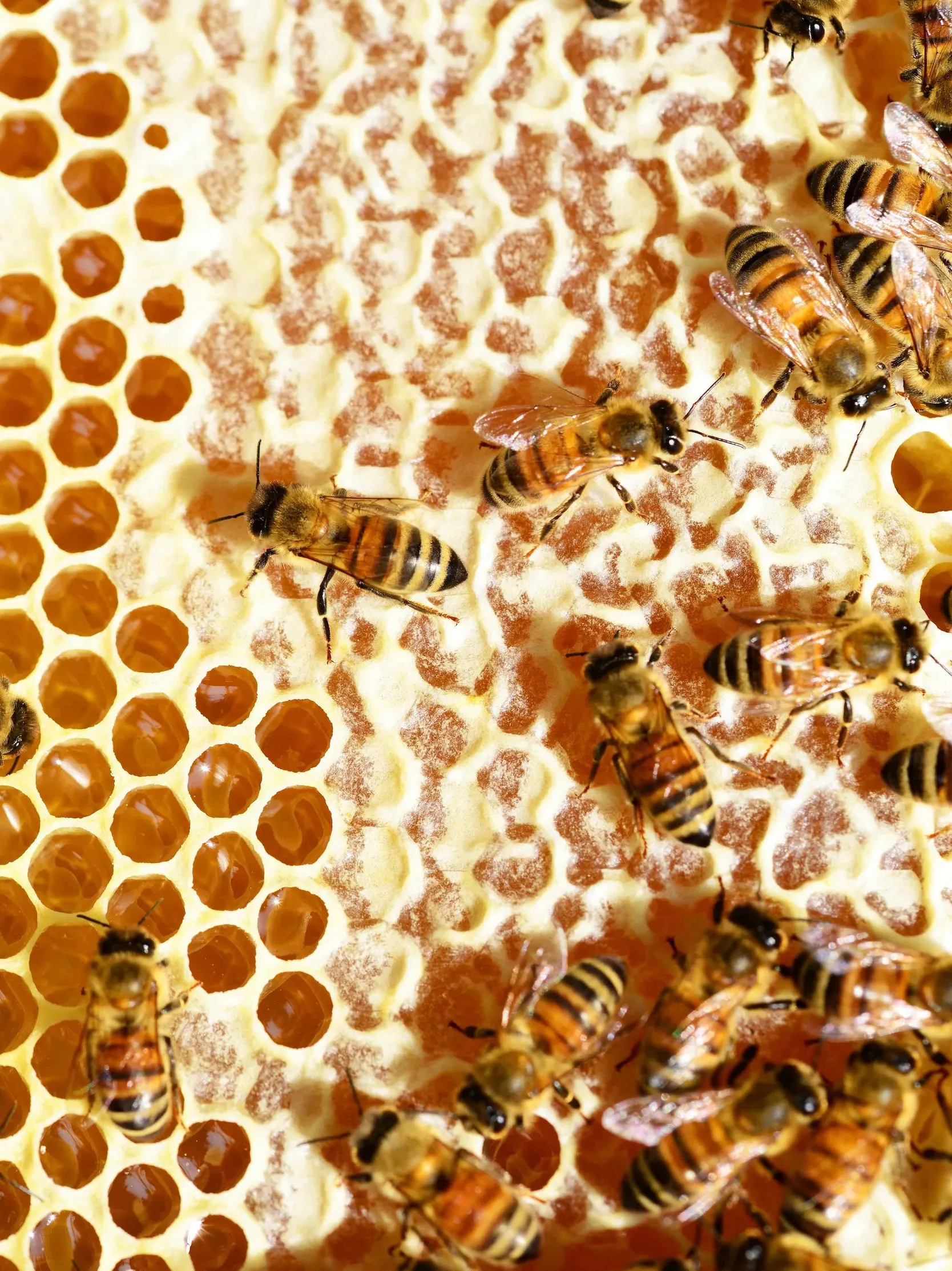
You can tell the difference between a frame of brood and a frame of honey by the size, weight, and color of the cells. Honey cells contain clear or amber liquid when uncapped, and have lightly-colored wavy and uneven wax cappings when complete. Brood cells contain either eggs, larvae, or pupae when uncapped, while the capped versions have individual, dark brown bullet-shaped cappings. Honey frames are also much heavier than brood frames, and experienced beekeepers can tell what's in a frame without even looking at it based on its weight. Making this distinction between frames of brood and honey is the first step towards deciding which frames to harvest.
Pictured Below:
Capped Honey (left) (top) vs Capped Worker Brood (right) (bottom)
After establishing which frames contain nectar and honey, the next step is to decide which frames are ready to harvest. When forager bees visit flowers, they use their proboscis to extract the nectar into their honey crop (which is separate from their stomach). They then return to the hive and regurgitate the nectar into another bee's honey stomach (gross, we know). This process repeats many times, and is essential to honey production, since each time nectar passes to a new bee it receives a dose of enzymes that help break down the complex sucrose in nectar into simpler forms (fructose and glucose).
Once the nectar has been passed between multiple worker bees, it's deposited into a honeycomb cell. Interestingly, honeybees are quite particular about where they store their food, and expert beekeepers note that different frames appear to be isolated based on the nectar's source flower. Whether this is by intention or simply a byproduct of the changing flowers as the bees expand their honey collection has not been definitively established.
Unfortunately for bees, simply foraging the nectar and returning it to the hive is only half of the work. For the next one to two months, the nectar will slowly be dehydrated and heated, reducing its water content and slowly transitioning it to a thicker, darker form that we call honey. Honeybees accomplish this through a complex teamwork process of fanning air throughout the entire hive: pushing drier air in, heating it to increase its condensation point and allowing it to hold more water vapor, and then finally venting it out the back or top of the hive. It's tough work, and takes an enormous effort on the bees' part.
So, why do bees spend so much time and energy dehydrating nectar? Well, nectar comes into the hive at around an 80% water concentration. Without preservatives, nectar will eventually ferment, leading to foul odor and unpleasant tastes, along with reducing its sugar content and lowering its nutritional value for the bees, as well as encouraging bacterial and fungal growth. Like most foods, it will eventually spoil. Honeybees intuitively know this, and work tirelessly to reduce the water composition of nectar down to around 20%, at which point it's considered honey. Once the honey has reached a satisfactory consistency (usually around 17-18% water content), the bees will seal off the cell with a thin layer of wax capping, thus preserving the honey for future use.
Beekeepers prefer to only harvest honey once it's been capped off by the bees. This ensures that it is at a stable moisture content, and will remain fresh for a long time. There is some disagreement on how much of a frame should be capped before it is ready to harvest, but the general consensus is that over 80% of the cells should be sealed off (or capped) before extracting the honey. If you harvest a frame with too much uncapped nectar, you will likely find the honey is thinner, not as sweet, and of a lighter color than typical honey. More importantly, this honey won't have a very long shelf life and will need to be used up within 1-2 weeks or it will begin fermenting. Incredibly, when honey is reduced below the 20% water content threshold and sealed off, its shelf life is in the thousands of years. Archaeologists discovered honey pots in ancient Egyptian tombs , and to their surprise the honey still tasted fresh!
Honey, when in its pure form, is an incredible product. According to the U.S. National Library of Medicine , raw honey possesses several antimicrobial properties and has long been considered a traditional medicine for wounds and other human ailments. It often contains healthy enzymes and nutritional proteins from pollen, and can be used to reduce allergy symptoms during the spring season. Some types of honey are especially potent; for instance, Manuka honey from the Leptospermum Scoparium bush is famous for having been shown to aid the healing process of burns, eczema, digestive issues, and other skin diseases. It has been used to clear wound infections, serve as an antibiotic (even against resistant bacteria), and resolve gastrointestinal irritation.
Honey serves as an important source of food for bees and a wonderful treat for beekeepers, so it's important to appreciate the intense work they undergo to produce it.
There are four different methods of harvesting honey from a hive - the spin, drip, crush, and flow hive methods. Each style has its own benefits, and the best option for you depends on the tools at your disposal and the time you want to dedicate to harvesting. Some methods also allow you to preserve the wax combs for the bees to reuse, while other methods let you harvest the comb to convert into pure beeswax. We've broken down each method below based on ease, product yield, and tools required.
By far one of the most popular methods of harvesting honey, the spin method makes use of a honey extractor to spin honey out of the comb, similar to a centrifuge. Once you've selected frames for harvesting, the first step is to prepare your extractor for harvest. Ensure you've assembled it properly and washed out any previous use debris or manufacturer dust. Extractors typically have tall vertical frame holders spaced out inside of the cylindrical spinning drum, and depending on the model have different maximum frame limits.
You'll also need to uncap the comb cells in order for the extractor to be able to spin out honey. You can really use any sharp object to do this, but many beekeepers have dedicated uncapping forks or knives to make it easier to remove the wax cappings. Once you've finished uncapping, place the frames inside the extractor, making sure to space out the frames as evenly as possible so that one side of the extractor isn't out of balance with the other.
Now comes the hard part. If your extractor doesn't feature an electric motor, you'll need to manually spin the frames long enough to extract the honey out of the cells and onto the drum wall. This usually takes about 5-10 minutes per set of frames, but can be sped up by extracting on a warm day, as honey is thinner at warmer temperatures. Once the frames are completely extracted (you can tell by inspecting the comb cells and by the frame's weight), you can return the swap the frames out with a new set and continue extracting. Most extractors have a spout at the bottom that lets you drain honey out of the bottom and into a bucket to be stored for later. We recommend using a strainer to filter out particulates or other debris that may have fallen into the honey during extraction.
Honey extractors are quite convenient when it comes to saving time and maximizing honey yield. They also let you preserve honeycomb for returning to the hive, which the bees will clean up and refill with more nectar. It's important to only use frames with foundation in an extractor, as foundationless comb is not strong enough to withstand the spinning force and will likely collapse and fall into your honey.
The downsides of using an extractor are that they can take some manual effort on the beekeeper's part, especially if the extractor doesn't have a motor for spinning attached. Furthermore, extractors tend to be on the more expensive side, and may be less appealing to those looking to save on costs of beekeeping.
Perhaps the simplest method for extracting honey, the drip method takes advantage of honey's lower viscosity at high temperatures as well as gravity to harvest frames. After uncapping the comb cells using a fork, knife, or other tool, simply lay the frame horizontally over a collection tray or bucket, letting the honey drip naturally out of the cells. This method, while trivial, can take quite a bit longer per frame, as it relies on gravity as a passive force compared to the much stronger centrifugal force of an extractor. It's also important to only use this method in a warm room sheltered from the outdoors, as leaving honey frames out for more than a few minutes will most certainly attract foraging bees, and before long lead to a robbing frenzy.
If you don't mind getting your hands dirty, this method can be one of the most enjoyable ways of harvesting honey. Simply put, it involves cutting honeycomb directly out of the frame and crushing the comb in a strainer, massaging out the honey and pressing it through the strainer into a collection chamber below. Unfortunately, some of the honey becomes trapped in the resulting beeswax clump, and it can be near impossible to harvest all of it. On the bright side, this method leaves you with a large collection of beeswax which you can then melt down and render into clean wax. Of course, the bees will need to rebuild the frames from scratch; however, for beekeepers with strong hives that need regular frame rotations, this is usually of little concern.
For beekeepers who want a beautiful display of fresh honeycomb ready for biting into, harvesting comb directly is the way to go. All you need is a knife and a frame of foundationless comb. Slice the comb directly out of the frame in whatever shape you desire (rectangles, circles, hearts, etc). Plate with a charcuterie board or eat immediately after harvesting. After chewing it up, the wax comb can either be swallowed or spit out. Make sure to save the wax for melting down later!
Pro tip: We highly recommend freezing any harvested comb that isn't immediately eaten for 24 hours. Bees are normally very clean and do a good job of protecting their honey, but every once in a while a stray beetle or moth may end up in your harvest. Freezing the comb ensures that anything still stuck on or in the comb dies before it can do damage.
Thanks to the more recent developments of Flow Hive , a fourth option exists for harvesting honey non-intrusively. Flow frames are plastic frames that use a physical locking mechanism for opening and closing honey comb cells. These cells are prepared by bees, filled with honey, and then sealed off as normal. The beekeeper then uses an unlocking tool to twist the cells out of place, sliding every other hexagonal cell upwards and breaking the sealed walls of the cell. The honey then drips down through a series of channels into a collection pipe at the bottom of the frame, which then flows out the back end of the hive and into a jar or bucket.
An obvious benefit to this method is the lack of intrusion into the beehive, thus avoiding angry or hungry bees and minimizing beekeeper labor. Of course, this does not mean that the beekeeper can simply avoid opening up the hive at all, as hive inspections are still a critical part of beekeeping. But this method does have its merits, and it's worth taking into consideration the ease of use and modularity that comes with these types of frames.
Some beekeepers have reported that Flow frames have a lower chance of being used by the bees, with some stating that honeybees refuse to use the frames at all. However, we can confirm that these frames do work in general, and many experts have also tried out the frames with general success in harvesting. As with most things in beekeeping, there is no one right way of doing things, and making decisions for your hive practices often comes down to beekeeper preference and doing what works for you. We highly recommend you try out multiple methods of harvesting, figuring out which method you prefer and sticking with that.
Regardless of the method you use, it's important to extract honey indoors or far away from your beehives. Honey bees are strongly attracted to the scent of honey, and can't resist going after such a large amount set out for extraction. You'll need to time your harvest accordingly, either keeping the process under 30 minutes or extracting on a cloudier day with less forager activity. Otherwise, you may find yourself in a feeding frenzy, which can inadvertently lead robber bees to your own hives if they're close by.
The bees in this video are robbing honey from several harvested frames and utensils shortly after a honey harvest. Honeybees can smell honey from very far away, and it can take as little as 5 minutes for robbing to begin if honey is left out on a warm sunny day. The best way to protect your hives from robbing is to only harvest honey very far away from them, on a day when it's cold and cloudy, or inside otherwise.
We suggest learning more about how and why honeybees rob.
© BeekPedia. All Rights Reserved.
Images and videos provided courtesy of copyright owners.