Last Updated 26 March 2023
Honeybees are naturally driven to insulated, sheltered cavities in trees, buildings, and caves. As a beekeeper, providing artificial hives that match their natural homes as closely as possible is a must. While there are many different types of artificial hives, the vast majority of them are either of Langstroth or top bar design. As such, this article will focus on the designs and specific parts of these hives. We recommend following up your reading with further research of these hive designs, and choosing between one of these as your go-to hive, especially if you are a beginner beekeeper.
Continue reading below to learn about each of the parts of Langstroth and top bar beehives, and how they all come together.
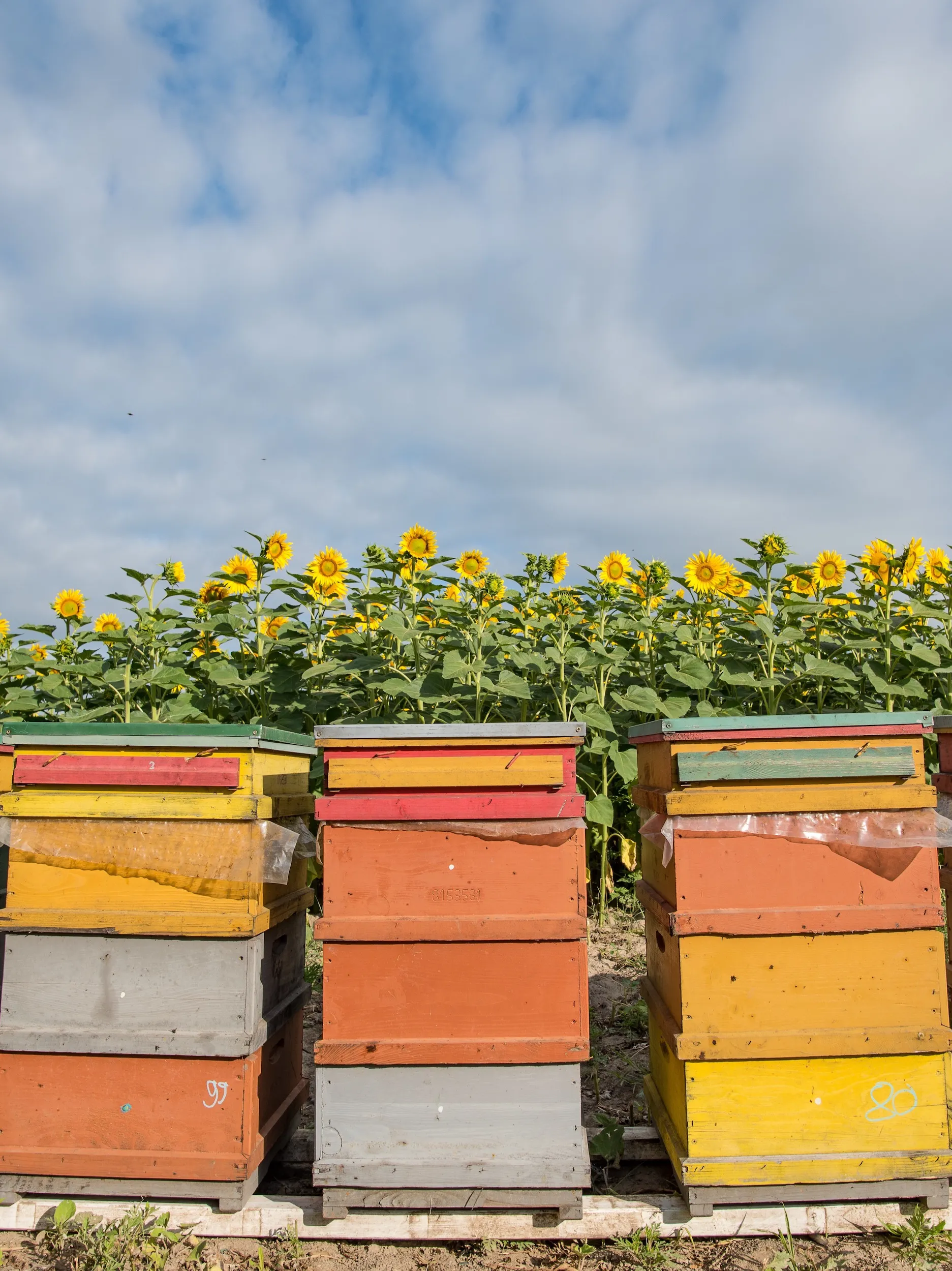
Designed by the American beekeeper Lorenzo Langstroth , Langstroth hives are the commonplace of modern beehive designs. Widely accepted and used throughout most of the western world, this hive prioritizes modularity and ease of use, while mimicking the natural internal tree-like structure that bees prefer to reside in. Boxes can be added or removed depending on the season, hive strength, and beekeeper goals, and individual frames can be removed or added during inspections to maintain colony health. While the modularity and individual frame access are convenient, there are drawbacks that come with this hive, mainly the cumbersome nature of having to remove and re-stack boxes each time you open the hive. Use the interactive model below to learn more about each part of the Langstroth hive design.
Click on an icon within the diagram above to view more info about the Langstroth hive. Or, read about the interior and accessory parts below.
In addition to the fundamental hive components, there are also several additional pieces needed to complete a Langstroth hive. Read more about these pieces in detail below.
The standard Langstroth frames are designed to provide ease of access and interchangeability with minimum hive intrusion. Standard Langstroth boxes have either 8 or 10 frames in each box. The frames should be evenly spaced throughout the box, keeping any extra space to the outer edges of the box. Langstroth frames are specially designed to provide adequate bee space in between each frame, and have become the standard for both commercial and hobbyist honeybee colonies.
There are several variations to Langstroth frames, with each having its own strengths and purposes. The most common distinction between frames is whether they have foundation or not. Foundation refers to a plastic or wax strip that's placed in most or all of the interior of the frame. Foundation serves as a guide for wax working honeybees, giving them a strong foundation (get it?) on which to build the remainder of the honeycomb. It takes bees around 7 parts honey or nectar to make 1 part beeswax, so foundation saves the workers lots of time and resources in building out their home. Foundation also helps prevent cross-comb issues, which can severely impact a new colony's growth and beekeeper accessibility down the road.
On the converse, foundationless frames have empty space within the interior of the frame, giving the bees full freedom to build their comb however they please. Some beekeepers claim that this freedom allows for more customized and natural comb structure, leading to healthier hives, but this has yet to be definitively proven. Another advantage to foundationless frames is that they are usually accepted by the bees quicker than foundation frames, as honeybees tend to avoid objects that are unfamiliar to them (including plastic foundation). Some frame manufacturers paint a layer of wax over the plastic foundation, which helps encourage comb building.
Image courtesy of Valerie Tiner
Image courtesy of Valerie Tiner
Image courtesy of Valerie Tiner
Image courtesy of Valerie Tiner
If you do decide to use foundationless frames, extreme care must be taken while the bees are initially drawing out comb on the frames. Fresh comb is extremely fragile, and when only connected to the top of the frame it is very easy to accidentally knock or bend the comb off, leading to destroyed brood and very angry bees. Furthermore, since foundationless frames provide a completely empty space inside the box, beekeepers should check at least once a week while the bees are drawing comb in order to curb any cross-comb issues before they occur.
Both foundation and foundationless frames can be used effectively in honeybee hives, and choosing between them is completely up to you. Some beekeepers even choose to mix and match frames in the same hive, alternating between foundation and foundationless frames as a guideline for the workers to draw out the foundationless frames evenly.
Drone frames are another common type of frame used as a varroa mite prevention and capture solution. Varroa mites prefer the longer brood cycles and larger cells found in drone brood frames, and as such are about 10x more likely to be found in these cells. Drone frames are placed around the edges of the brood nest as a capture and kill method. They are foundation frames that exclusively provide guidelines for larger drone cells, so that once drone brood is laid and capped off in the frame, the beekeeper can then remove it, freeze it, and return it to the hive, trapping and killing off any varroa that are hiding within the cells.
Handling varroa is a complex topic, and we recommend reading more about it here.
Pictured Below:
Foundation Frame (left) (top) vs Drone Frame (right) (bottom)
Entrance reducers serve as protection for the colony, whether it be from the elements, intruders, or robbing bees. Beekeepers commonly use entrance reducers to protect their hives during weak periods of growth, such as during the fall and winter months or when a hive is just starting out. They come in many forms, such as wooden rectangles with carved out entrances, plastic covers with many tiny holes, or screen mesh affixed to either side of the entrance.
Reducers are a great tool to assist a weak hive, as they reduce the space needed to be guarded by the colony's workforce and can also prevent wind and rain from entering the hive. However, care should be taken for stronger, more populous hives - especially during summer - as entrance reducers can prevent the airflow necessary to allow the colony to cool down and dehydrate honey, and can cause traffic jams on especially busy foraging days. Paying attention to your hive's entrance and noting whether there seem to be fewer guard bees or more outside intrusion from predators or robbers is the easiest way to determine whether a reducer is needed.
Queen excluders are primarily used by commercial beekeepers to prevent the queen from moving upwards into the honey supers and laying brood, while still allowing the smaller worker bees through. While brood in the supers wouldn't cause an issue for the bees themselves, it would make honey frames with brood in them unable to be harvested until after the brood has hatched. Made up of a thin sheet of rectangular holes, excluders are placed between the brood box and the honey super.
There are metal and plastic variations of queen excluders, and some experts have noted that bees seem to have a harder time adapting and crossing through plastic excluders compared to metallic ones. The difference is likely negligible, however, and either material has been used effectively. A more important question is whether to use queen excluders at all. There are certain benefits to using queen excluders, namely avoiding the potential for brood to be laid in the honey supers. And if you're using a product like the Flow Hive® flow frames, it is critical to prevent brood from being laid in the super. However, for the average beekeeper, queen excluders are more of a convenience than a necessity. Additionally, some beekeepers have noted that honey production seems to be lower in hives that have excluders, but this remains to be proven.
Importantly, care should be taken when adding a queen excluder to a brand new hive, especially if the excluder, frames, or hive box haven't been used before. Bees are driven by smell, and if the queen excluder is unfamiliar to them, they may refuse to cross it for some time. Beekeepers can negate this issue by moving 1-3 frames of drawn-out comb above the queen excluder to coax the honeybees to move upwards, or by spraying sugar water and spreading wax on the area above the excluder.
The top bar hive design (sometimes referred to as horizontal hive) draws inspiration from older beehive structures found in parts of Africa, where native tribes would use large hollow tree trunks, orientated horizontally, in order to house a colony of honeybees. The beekeeper would have quick and easy access to the honeycomb, and the bees have plenty of room to expand when needed. This design is especially useful for beekeepers who struggle lifting the heavily-stacked boxes found in Langstroth hives, and allows access to all frames at once, compared to having to remove one box to access the space underneath. Additionally, top bar hives typically require less maintenance compared to Langstroth hives, and as long as the bees are given enough space to expand, the beekeeper will generally need to check on them less frequently assuming all else is well in the colony. However, given the foundationless frame design of these hives, cross-comb and burr comb can become an issue if left unchecked for too long. Use the interactive model below to learn more about each part of the top bar hive design.
Click on an icon within the diagram above to view more info about the top bar hive. Or, read about the interior and accessory parts below.
Similar to Langstroth hives, top bar hives use wooden frames to support honeycomb structures. However, unlike Langstroth counterparts, horizontal hives use top bar frames, meaning they have no supporting edges or bottom. While this gives the bees more freedom to draw comb where they please, it also presents an additional challenge for the beekeeper to keep comb tidy and prevent the bees from attaching frames to the sides of the hive body or other frames. The frames are also more fragile, as they have no support from foundation or frame edges, so care should be taken when removing or adding frames.
Image courtesy of Maja Dumat via CC 2.0 License
Overall, top bar hives are an excellent choice for beekeepers who prefer to take a hands-off approach to beekeeping, or who prefer to let bees draw their own comb and expand and contract their colony size as desired.
© BeekPedia. All Rights Reserved.
Images and videos provided courtesy of copyright owners.