Last Updated 16 July 2023
Just like us, honeybees need access to nutrient-rich food throughout the entire year. Colonies use energy to heat and cool the hive, workers expend energy during foraging flights, and young brood requires a steady flow of protein and carbohydrates to develop into mature adult bees. Beekeepers need to understand what types of food their colonies require at different points of the year as well as how to determine how much food each colony has currently stored. Without this crucial information, determining the strength of your colony is impossible.
Honeybees rely on only two main categories of food for their entire diet: pollen for protein and nectar for carbohydrates. Both of these come directly from flowers, having developed a symbiotic relationship over millions of years with bees. A long time ago, plants figured out that if they could attract flying fauna to their petals using a sugary treat, they could efficiently reproduce by spreading their pollen across the bodies of these animals and waiting for them to visit a neighboring plant of the same species, thus giving way to pollination. Nowadays, honeybees are responsible for pollinating around 1/3rd of our domestic crop agriculture, and many more wild plant species also depend on pollination to spread. Without this essential aspect of nature, many plant species would quickly disappear and humanity would struggle to exist.
But what's in it for the bees? As it turns out, pollen serves as an abundant source of both protein and essential nutrients that honeybees need to survive. And as plants evolved to produce nectar - a sugary treat packed full of carbohydrates - to coax pollinating insects to their flowers, they became the primary source for all that honeybees need to thrive.
Throughout the spring and summer months, most colonies' primary focus is spent on foraging these resources from nearby flora. As different plants flower at different points throughout the year, different types and colors of pollen and nectar become the main source of food for honeybee hives. Determining what your bees are foraging can be a bit tricky, and like most topics in beekeeping largely depends on your location. We'll cover this in more detail below.
Colony starvation is the second most common reason that honeybee colonies die out, just behind reason number one - varroa mites. Unlike mammals, honeybees (and insects in general) don't store much energy in their bodies for long-term use (except during the winter months). Instead, they store food in honeycomb cells in the form of bee bread and honey. If these stores become depleted, the colony will turn to the next closest available source of food. When there are plenty of flowers blooming, this is of little concern, as foraging bees will quickly replenish the food stores in a healthy hive. But during a dearth and winter, workers will cannibalize their own brood in an effort to stay alive. Once a colony begins to starve, maintaining an internal hive temperature of 95ºF becomes much more difficult. Eventually, chilled brood and other diseases will set in, and pests such as hive beetles or wax moths may begin to take over the hive. Once a colony has reached this stage of starvation, the chances of saving it are slim. Avoiding starvation altogether through substitute feeding can help ensure healthy colonies and a bountiful honey crop, preventing further complications down the road. Continue reading below to learn more about how to feed your colonies.
Often the source of springtime allergies, pollen is produced en masse during the spring and summer months by almost all flowering plant species. Pollination is one of the primary methods of plant reproduction, and honeybees are one of the main contributors to this process. But pollination is merely consequential to the bees - their primary focus is on bringing home the pollen itself. Pollen is packed full of protein and nutrients that honeybees need to survive, and a colony cannot raise brood without a sufficient supply of it.
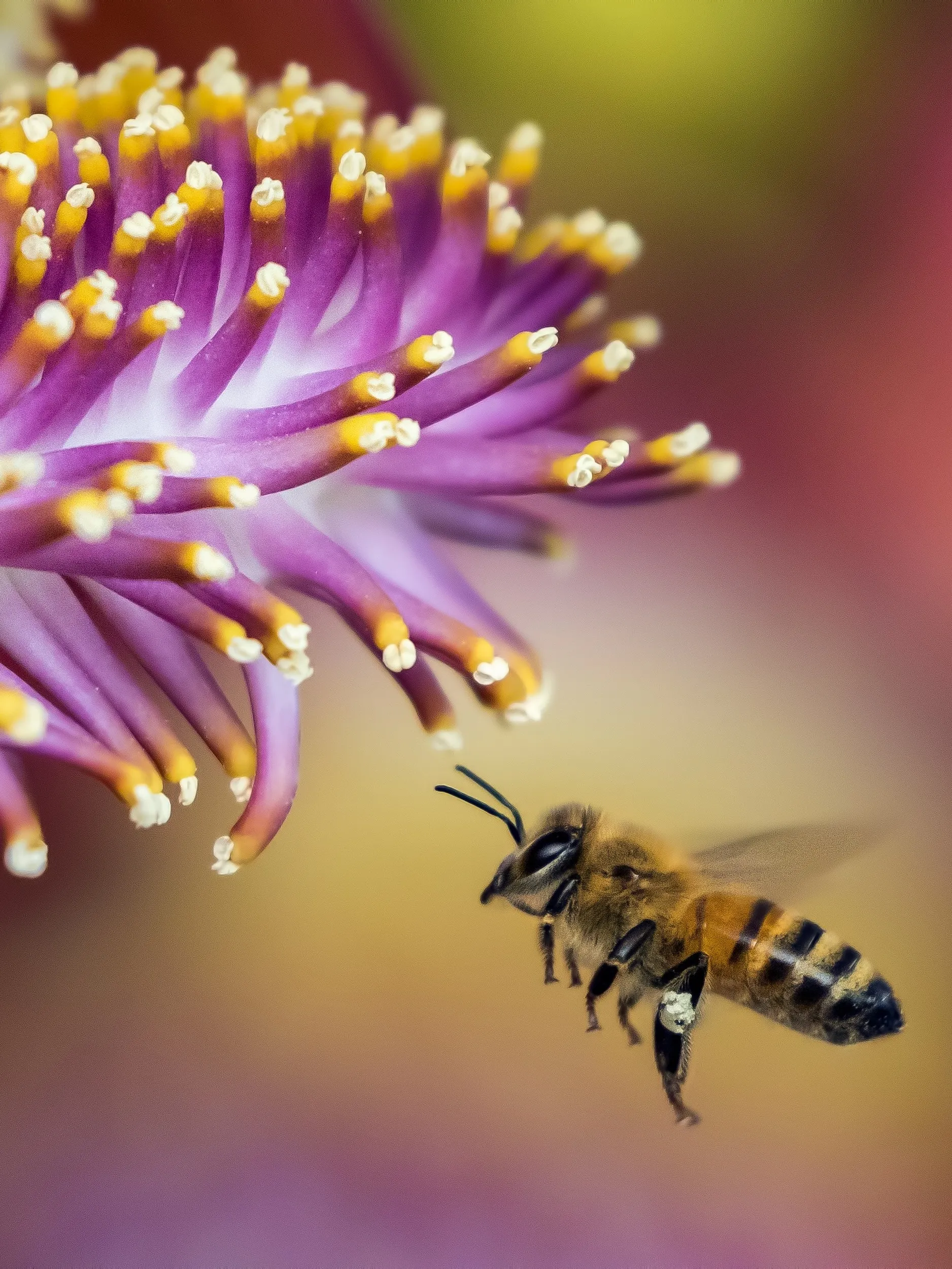
Foraging bees leave the hive in 10-30 minute trips throughout the day. During these trips, they visit thousand of flowers, but only visit a single flower variety per trip - you'll never see a bee with different colors of pollen on its legs. On each flower, the worker will walk around the petals, buzzing and shaking off the pollen. She is covered in thousands of tiny hairs that collect pollen granules around her body, which she then scrapes and packs into (relatively) large pouches at the end of her back legs, called pollen baskets. She'll then continue her journey on to the next flower, perhaps taking a few sips of nectar before returning to the hive.
Once inside, the worker finds an empty honeycomb cell and deposits the pollen baskets into the cell, before flying out again to gather more pollen. While she is away, a very interesting process occurs inside the hive. Other workers, called food storage bees, use their heads and forearms to pack the pollen balls very tightly at the back of the comb cell, before mixing it with a concoction of nectar and honeybee enzymes. The pollen is then allowed to ferment, rising and releasing more nutrients for the bees to eventually consume, along with producing natural preservatives that keep the pollen fresh for longer. This new substance is known as bee bread, and it serves as the main source of protein for developing brood, with a bit leftover for the adult bees and queen as well. The bees know not to consume the pollen or give it to the brood until the fermentation process is near completion, and have been observed to keep track of which pollen came in earliest and consume that first.
Depending on the specific flowers visited and the time of year, beekeepers may see a wide variety of colors of pollen stored in the hive. Below is a chart that details common colors of pollen and their likely sources. Contacting local beekeepers in your area is another great way to learn what flowers are blooming in your area.
The other primary source of food for the hive - nectar - is often the substance that people generally associate with honeybees. Flowers provide nectar in small droplets inside the center of their petals as incentive for more pollinating insects to visit them, and in turn, the aforementioned insects will come into contact with the flower's pollen grains and carry them to neighboring plants.
Honeybees specifically seek out nectar as their primary source of carbohydrates, and while foraging will drink up the sweet liquid using their proboscis, storing the nectar in their honey crop until returning to the hive. Once back at the colony, the forager is greeted by her sister workers. They transfer the nectar amongst themselves, sharing it around and mixing it with their gut enzymes to force the complex sugars to break down into simpler forms (namely glucose and fructose).
Once the nectar has been transferred between several workers, it's then deposited into a cell, where it begins the dehydration process of turning into honey. Workers prefer to deposit honey in free cells surrounding the brood nest, usually in a circular pattern around the top of the central frames and completely filling up the frames towards the edges of the hive.
Given that honey is such a diverse topic, we've written an entirely separate article dedicated to how honey is produced from nectar, as well as how to harvest your colony's surplus. We recommend giving it a read to further understand how much honey a colony needs throughout the year, and when it's ok to take some for yourself!
Royal jelly is a particularly interesting substance produced in the hive. Young nurse bees secrete royal jelly from their heads, and feed the substance to developing larvae just after hatching. After about 3 days of being fed royal jelly, drone and worker larvae are switched to a diet of bee bread and nectar. However, queen bee larvae are exclusively fed royal jelly up until the day they are capped and begin metamorphosizing. It's believed that specific compounds within the royal jelly are what stimulate queen larvae to develop into a queen, rather than a worker.
Consuming royal jelly is believed to have a multitude of health benefits, including antioxidant and anti-inflammatory effects, lowering the risk of heart disease, aiding in injury healing, lowering allergic responses to pollen, promoting gastrointestinal health, repairing and supporting collagen in skin, and even relieving depression. Some of these benefits are still under scientific scrutiny, and should be considered unlikely until proven otherwise. However, the general consensus is that royal jelly is a potent nutritional food for both bees and their keepers.
As a beekeeper, it sometimes is necessary to provide your own substitute food for your colonies, lest they starve and die. For example, during long periods of dearth or the winter season, flowers are scarce and the bees aren't foraging. Or, in the case of brand new colonies without an established forager workforce, substitute food may be their only source of protein and energy.
During the spring and summer months, we recommend 1 frame of food (pollen and nectar) for every 1 frame of brood. During the late fall up to and throughout winter, your bees should have between 60-80 pounds (1-2 deep boxes) stored full of honey, though colder climates may require even more. Honeybees will usually scale down their brood production and food consumption during a dearth and winter, but it's still important to keep a close eye on them, especially if they've recently swarmed and taken lots of honey with them.
If your colony is low on nectar or honey, we recommend feeding them sugar as a substitute carbohydrate source. The delivery method for this sugar depends highly on the weather - if you're feeding during the spring and summer, we recommend feeding a 1:1 ratio of granulated plain white sugar to water solution through a hive top feeder or mason jar. A 1:1 solution will stimulate hive growth, and cause wax worker bees to begin producing wax and expanding the hive. Alternatively, feeding a colony a 2:1 sugar-to-water ratio will typically encourage the bees to store the solution inside honeycomb cells, dehydrating the sugar syrup into faux honey. This ratio is typically used during the fall, when beekeepers want their bees to prepare for the winter by storing excess honey. We don't recommend feeding during a honey flow when you have honey supers on the hive since you might just end up with sugar syrup for your harvest. Also, be wary of feeding outside the entrance of the hive, which can attract robbing bees and other nasty pests.
If instead, your colony needs sugar during the winter, we recommend feeding them solid sugar in the form of either candy fondant or plain sugar granules. There are many different recipes online regarding honeybee fondant, but the consensus is to mix 1 part water, 4 parts granulated plain white sugar, and a tablespoon of apple cider vinegar in a large pot. Using a candy thermometer, the mixture should be heated until it reaches the 'soft ball' stage, at which point it should be cooled, beaten, and poured into a container wrapped in newspaper or parchment paper. It should then be cooled in the fridge, where it will harden into a fondant cake that can then be placed on top of the frames inside a hive.
It's very important to only use pure, granulated white sugar. Don't use brown sugar, or sugar with preservatives such as corn starch. Feeding this to your bees can likely cause dysentery and other health problems, or they may just not consume it.
For further explanation, here's a great video detailing exactly how to make the fondant:
Pollen substitutes can be used to stimulate brood production right before an expected nectar flow. These are typically given in the form of either patties laid out over the tops of frames, or through a substitute powder poured at the entrance of the hive. Caution should be used when feeding substitute pollen, as this will stimulate the honeybee queen to begin laying more eggs, leading to a large population boost in a few weeks. If you feed extra pollen during a dearth or winter, there's a good chance you'll be artificially accelerating the hive's growth during a time when they should be conserving resources and energy, and may lead to lower nectar/honey stores down the road.
For further explanation, watch this video demonstrating how to feed a pollen patty to a hive, including a pollen patty recipe at the end:
Generally speaking, honeybees are incredibly efficient and conservative with their food. They're one of the best-evolved species for living on our planet, and for thousands of years have not required human intervention to survive. Why then, do we need to feed colonies at all?
In short, having to feed a colony is usually due to one of three reasons. First, the colony was formed recently and hasn't had enough time to build up its resources in preparation for winter. Second, the colony's genetics are weak or something is wrong with the queen, or the colony has been robbed or attacked by a predator. Third, a beekeeper took a large amount of food from the hive and left the colony without sufficient stores for the winter. The first two of these cases happen in nature all the time - nature selects the strongest of the species and culls the rest. Of course with an artificial hive owned by a beekeeper, it's expensive and disheartening to have your colony die out, so we take measures to prevent this from happening. The third reason is simply due to beekeeper interference - since we take out honey, we sometimes need to give the hive something in return.
In general, feeding your bees should be a measure of last resort. Sugar water is not as nutritious as nectar, and pollen patties can artificially expand a hive past its self-supporting limits. Leaving your bees be (no pun intended) is typically the best practice, only feeding when necessary or after harvesting honey.
Honeybees consume a mix of pollen (in the form of bee bread) and nectar/honey. Bee bread consists of pollen packed together with nectar and honeybee enzymes allowed to ferment and rise in the hive. Both pollen and nectar come from flowers, and honeybees go out foraging daily during the spring through the fall to gather these essential ingredients.
During the spring and summer months, we recommend 1 frame of food (pollen and nectar) for every 1 frame of brood. During the late fall up to and throughout winter, your bees should have between 60-80 pounds (1-2 deep boxes) stored full of honey, though colder climates may require even more. Honeybees will usually scale down their brood production and food consumption during a dearth and winter, but it's still important to keep a close eye on them, especially if they've recently swarmed and taken lots of honey with them.
You should feed a honeybee hive only when absolutely necessary and when they are low on food. For example, if the colony is just starting out or if foraging bees haven't been bringing in enough food to sustain the colony. It's important to inspect beehives every 1-2 weeks to check how much is stored in the hive, as bees cannot go long without food.
If your colony is low on nectar or honey, we recommend feeding them sugar as a substitute carbohydrate source. A 1:1 sugar to water solution will stimulate hive growth, and cause wax worker bees to begin producing wax and expanding the hive. Alternatively, feeding a colony a 2:1 sugar-to-water ratio will typically encourage the bees to store the solution inside honeycomb cells, dehydrating the sugar syrup into faux honey. This ratio is best used during the fall, when beekeepers want their bees to prepare for the winter by storing excess honey. We don't recommend feeding during a honey flow when you have honey supers on the hive since you might just end up with sugar syrup for your harvest. Also, be wary of feeding outside the entrance of the hive, which can attract robbing bees and other nasty pests. Pollen patties can also be used to stimulate brood production, but should only be given when a beekeeper expects a strong honey flow within the next month.
Never feed your bees honey bought from the store! Nearly 95% of retail store honey contains American Foulbrood spores, and can infect your hive with the horrible pathogen. Instead, feed your bees honey sourced locally from your own hives, or with 1:1 sugar water.
Bee bread is a mixture of pollen, nectar, and honeybee enzymes that has been allowed to ferment and rise (hence the name bread). It serves as the main source of protein for developing honeybees, as well as a small snack for adult bees. Bee bread is typically very healthy to consume for humans as well, since it's packed with nutrients and plant proteins.
Royal jelly is produced on the heads of young nurse honeybees, and fed to developing larvae just after hatching. After about 3 days of being fed royal jelly, drone and worker larvae are switched to a diet of bee bread and nectar. However, queen bee larvae are exclusively fed royal jelly up until the day they are capped and begin metamorphosizing. It's believed that specific compounds within the royal jelly are what stimulate queen larvae to develop into a queen, rather than a worker.
Consuming royal jelly is believed to have a multitude of health benefits, including antioxidant and anti-inflammatory effects, lowering the risk of heart disease, aiding in injury healing, lowering allergic responses to pollen, promoting gastrointestinal health, repairing and supporting collagen in skin, and even relieving depression. Some of these benefits are still under scientific scrutiny, and should be considered unlikely until proven otherwise. However, the general consensus is that royal jelly is a potent nutritional food for both bees and their keepers.
© BeekPedia. All Rights Reserved.
Images and videos provided courtesy of copyright owners.